A simple blueprint for resolving trauma.

Human responses to trauma, the symptoms, the diagnosis, the neuroscience, the varied treatments and the possibility of chronic mental ill health if treatment is not effective,  make working with trauma daunting to the young practitioner. The more we complexify it, the more family, friends, communities and workplaces step back from ordinary human healing connection and defer to experts.

I like to emphasise human resilience, and come from the belief that human beings are actually pretty good at healing, if we keep it simple and ordinary and link it to an established process. Sir William Osler said “I suture the wound, but God heals it” (whatever your God may be)

We get good at trusting that if we cut ourselves or break a bone it will heal, but in our culture we are not so good at learning to trust that our emotional wounds will also heal. If you break your leg, you put a plaster on and it heals, but we aren’t so good at knowing what the plaster is for an emotional wound, and tend to let these wounds get poked, adding to the pain and slowing the healing.

I like to tell clients who have suffered trauma that people get over trauma the way a woman gets over childbirth. The experience is often pretty intense and commonly medicalised and a bit frightening. But then theres a baby to distract you from your own experience and then there are visitors with joyful smiles who want to listen to you share your experience, so you get to retell it in a different emotion, and lay it down again in your memory with a softer, safer emotion. And you retell it many times to many visitors until the emotion becomes bland. By the time the baby is about 6 weeks old you start to think, “That wasn’t so bad, I could definitely do that again.”

Some years ago I was in the immediate vicinity in the moments following an armed robbery. The shop senior was assaulted and I was presented with her immediately following the event. She was in a state of distress, almost howling in a possessed way. The person with her was noticeably distressed at her distress.
I just sat with her…I think I asked a question and cracked a joke about our small town, how that kind of thing doesn’t happen here. She stopped wailing and looked curiously at my calm demeanour and began to speak of what had happened. She kept saying she felt like such a twit. She was the senior and SHE fell apart, everyone else was fine. I pointed out that they were fine because she was dealing with it so they didn’t need to. She kept saying she felt like such a twit. She was OK as it was happening, gave him the money after being shoved around, and then when he left she fell apart.  I said… “you see that in war…the captain gets blown up by a mine, goes on to secure the situation, make sure everyone that he is responsible for is ok, and then looks down to discover his leg’s been blown off.” She looked at me in a certain steady way, there was a moment of silence as she was making connections, and then she said… “I’ve got to get back”, and spoke about the shop junior, implying her responsibilities.

I reminded her how it can feel to be jetlagged. You arrive somewhere and it’s as if your experience has to catch up with you. All the emotional responses that were appropriate during the robbery were put on hold and then happened all at once afterwards. I presupposed she’d now caught up with herself. I mentioned the thing she did in not taking him seriously at first resulting in getting pushed around as an opportunity to learn, but she stopped me and said that it seemed like minutes but was probably only seconds, she thought he was joking and laughed at him, he shoved her, and then she reacted appropriately. She was convincing me!

Then she started saying “what a twit” a few times and I realised she wasn’t speaking about herself anymore so I said “him?”…and she said “Yes!!” and ranted about what an idiot he was, how he wasn’t even wearing a balaclava. She said with certainty that she would recognise him again, that she knew what he looked like. Then she said again that she had to get back. The whole conversation had taken little more than five minutes. She stood up confidently and said to me…I feel like hugging you…who are you again? I laughed and told her my name, and felt very sure she’d recognise me again!
She dropped back an hour and a half later to tell everyone they were back in business and the police had left. She looked very much back in the driver’s seat of her experience.

The next morning I was told by someone who had checked on her that she was teary, and hadn’t slept the previous night. They were worried and thought I should know. It seemed important not to respond straight away, so I worked until lunchtime and went down to discover a very calm, confident woman, who had told the story to dozens of customers who had heard and wanted to find out what had happened. She told me she hadn’t slept. I said I would be worried if she had. That I didn’t know any normal human beings who would have slept well after such a day. I said I expected her to sleep poorly again, and maybe even for a few more nights, perhaps as many as 5 nights, but by the 6th night I expected her to be sleeping more normally. She agreed and said that after a few hours she had decided to watch a movie, and then she got a little sleep. I congratulated her and revised my estimate of her sleeplessness to 3 or 4 nights. She went on to tell me the “twit of a man” went on to the next suburb and did the same thing there. That shop assistant was sent home and wasn’t doing too well. She told me with authority how wrong it was that she was sent home. And talked in detail as if to teach me the appropriate management of such a person! I then made the observation to her that she had a lot to offer in assisting everyone else involved.

Dissociation is a very normal and very human response to a traumatic event and allows us to function in that event. In reflecting on what is useful in reconnecting an individual, either immediately or years later, it seems a process of associating them, and focussing them, while allowing the emotion to settle, or by attaching a more useful emotion or body experience to the traumatic event.

I have also noticed that people with no training often respond very usefully to someone in distress. The people who put their own responses aside are usually humanly helpful. I remember a story of a small boy who was saved from near drowning by his 8 year old brother who had a vague idea of CPR. Some acronyms are useful. I wonder if mind body resuscitation (MBR) might bring a more useful focus to trauma management, and help to redress the fear and paralysis that “PTSD” brings.

It can be so simply satisfying to observe and be part of another’s reconnecting. I would say that MBR involves;

D-Disconnecting from your own upset in order to be useful to the other.
S-Sitting with and being present and allowing the other to be present.
M-Marrying the emotional response to the events and allowing them to settle.
4-forgetting unhelpful acronyms.
WORKING WITH DISSOCIATION: When reconnecting is not enough

As a medical undergraduate, I found Psychiatry to be such a strange abstraction, that seemed to be about types of people that I’d never met. I was taught that neurosis was something that was within normal human experience, but that psychosis was not. It just didn’t prepare me to deal with patients in General Practice who suffered from extreme forms of dissociation, and I felt ill equipped to help. Somewhere in the next 10 years I discovered how to see the person, not the DSM category, and got to know many interesting individuals, who reminded me of a lot of people I had met in my life. I could see that my part in actively building our relationship helped them. When I then began to learn about Solution Oriented Therapy and then the work of Milton Erickson, I finally discovered that there were ways that I could be more useful.

Now, another 16 years on, I would have some things to say to my younger self. I would tell her that dissociation is in fact a normal human experience. I would remind her of the imaginary games she played as a kid where textured stories unfolded and it was as if these things were really happening.  I would remind her of her daydreams, where quite bizarre realities could feel very real. I would remind her of the time she had a fever and floated around the ceiling looking down on herself, managing not to be afraid because of the soothing voice of her mother. I would remind her of the time when she was sitting in the sun in the family room and saw her old grey tabby cat out of the corner of her eye, and then, when she turned to talk to him, it was just a bundled up jumper, not even the right colour really, and she was so surprised at how real he had seemed that she tried to get that vision again out of the corner of her eye… but couldn’t. I would remind her of the creative spaces she would get into, drawing, building, creating, with ideas that defied logic, as the “real world” disappeared and time sped up, or slowed down. Then there were those optical illusions, and magic eye images. If she could be so easily tricked, couldn’t anyone?

She knew then, that in the moment of perceiving, there was no way of knowing the difference between an illusion and reality, so what was so hard to understand about someone hallucinating, or getting stuck in an unhelpful delusion. By seeing dissociation on a spectrum of normal everyday experiences it is easier to understand, and therefore easier to connect with clients who experience it.

Dissociative skills are helpful when fear and trauma drive someone to want to get out of their own experience. Dissociation becomes a haven, an escape from an unwanted bodily experience, but the mood of this dissociating is sometimes very different to a playful daydream. It is a very useful skill while the danger and damage is still happening, but can be problematic if it is hanging around when the danger has passed. The most remarkable description of the protective nature of dissociation I have heard was from a man who’s childhood was a constant barrage of verbal, emotional, physical and sexual abuse, and yet somehow he managed to really believe that he was lovable. He let himself experience love, sometimes in magical ways. In primary school he pretended that his loving teacher was actually his father, and every morning his teacher greeted him he felt it as a ‘good morning’ from a loving father. He went on to have a successful life, married and had children, and had fulfilling relationships with all of them. He developed enough control of his dissociation that it became psychologically protective in any dangerous situation, and shielded him from pain. If that was possible for him, just imagine what we are able to co-create in a therapeutic relationship.

Most people have daydreamed in class but remain aware enough of “reality” that they hear their name if asked a question, even if they weren’t present for what was said. People rarely wet themselves because they were so absorbed in a daydream that they didn’t attend to a full bladder. You can be absorbed in a book, but still answer the phone when it rings, adjusting quickly to the new reality.

Neuroscience informs us that what the brain practices it gets good at, and people with extreme dissociation have certainly practiced. If there were a competition for dissociative skills, these people would be the Olympic team. Olympians, however, leave their skills on the field. They don’t tend to hurl javelins at the dinner table, and so don’t appear strange to us.

My take on dissociation, when it is a problem, is just that control has been lost. Fear gets in the way of learning, so the more ordinary we can make these experiences, the more connections to everyday examples we make, the easier it is to learn, and to reclaim control.

I have noticed that people who dissociate in a problematic way, very often have learned a few tricks to stay in the room. I had a client who would scratch his palm with the fingernails of the same hand, another who placed a hand on her shoulder under her shirt and kept the awareness of the touch. Others who pick at clothing. I have noticed that complimenting them on finding a way to stay in the room often surprises them as they don’t know they are doing it, but as soon as they realise they are more in control. I then wonder with them what other things they do that they don’t even know they are doing, and often surprising rememberings appear.

The phenomenon of dissociation can be seen in all problems that clients present with, from learning difficulties in school children, through fears and phobias, trauma responses, to the more extreme end of the spectrum of dissociative disorders, and schizophrenia. Most therapy models generate an experience of reconnection, so that a client goes from a disconnected (all over the place like a mad woman’s knitting) experience, to a connected (cooking with gas) experience, where client resources become available again, and learning can happen. However, when the client does not have control of their own dissociative experience, simply generating reconnection will not be enough.

Dissociation is a powerful skill, that can veer out of control when no-one is in the drivers seat. By understanding and utilising this ability, a therapist can work with a client to enable them to grasp the wheel of their own experience. When helping a client to explore the phenomenon of their own dissociation, we can be a useful mentor in the passenger seat of the client’s experience as they discover that they can drive.


Tests test the test, not the tested

If all the people in the world lay on the ground, head to foot around the world, two thirds would drown.

I was a medical student when I heard this absurd statement. Perhaps I was not quite ready to see the relevance to statistical proclamations about humans, but something about it has always tickled me. Human beings are just not standard enough for statistical statements about them to remain static decade after decade. People are getting taller, larger, living longer, surviving childbirth more often, and all the while the planet remains two thirds covered by water. So what does a statistic that stays the same mean?

A good example is Herbert Spiegel’s hypnotisability scale. I never much liked the notion, but if you do it, you find 25% of the population are not hypnotisable. Stories of Erickson’s students turning up at these demonstrations and helping these non hypnotisable people experience trance in their own way, of course appeal to my mischievous side. The finding is a result of the construct of the test itself.

So what of the effectiveness of psychotherapy that has remained the same for the more than 50 years that we have been measuring it? What if it doesn’t actually say anything about people, it just measures the construct of psychotherapy and the goals therein?

Heinz Von Foerser, one of my heroes seemed to understand this kind of thing. He said that tests test the test, not the person being tested.


DSM 5: the answer to life, the universe, and everything?

Those of you who are Douglass Adams fans will recall The Hitchhikers Guide To The Galaxy where the great supercomputer Deep Thought spent 7 1/2 million years calculating the answer to the great question of life the universe and everything, and came up with the answer of 42.

Well so too, the “DSM 5 machine” developed to ground DSM in science, not rhetoric, and solve once and for all the validity and reliability issues that plagued it.

The answer….. the answer…… you’re not going to like it….. is…. is, well no diagnosis meets the gold standard for reliability and most are no better than chance.

As a practitioner, working at the coal face seeing clients, it seems glaringly obvious that the system is broken. The medical model just hasn’t worked for dealing with emotional issues in human beings. But the coal face can be a lonely place, so I was heartened to watch this talk by Psychiatrist Sami Timimi of the NHS and University of Lincoln UK.

Every other area of medicine has shown some kind of improvement in the last 50 years, but not so mental health.

Deep thought defends himself by saying, “well you never actually knew what the question was” and in true Douglass Adams form, he goes on to design a supercomputer so complex that organic life forms part of it’s operational matrices, and he names it “The Earth” and of course the mice are running it!

Seems familiar?

And if you think that is provocative, have a look at this. Professor Peter Gotzsche, who has a solid track record of research and published more than 50 papers in leading journals speaks about how most of what the drug companies do “fullfills the criteria for organised crime in U.S law”

Food for thought and a not so peaceful Sunday!


Trauma by many other names

A man in his 50’s whom I worked with for some time has, I suspect, broken the record for the number of well intended diagnoses he received before the clarity of his trauma response became clear.

His life before the age of 5 was not easy. His parents were violent with each other and sometimes with him. He learned to duck for cover and keep pretty quiet. He flew under the radar until he hit school where at first he was withdrawn, afraid and overwhelmed. He daydreamed a lot. It didn’t take long before his peers began to poke this slightly odd and awkward fellow, and he retaliated in the way he had learned how, with the force of self preservation and primal fear. Then he was punished and made to feel bad about himself, while his attacker was soothed and protected. He could make no sense of this but soon learned that adults were as dangerous as his taunting peers. He learned that there was something wrong with him and he was to blame. He didn’t notice that teachers cared, but didn’t know what to do. He didn’t notice their exasperation or desperation, he just felt the hurts and the danger.

He didn’t learn. School was a daily battle ground, not a place for exploration. Finally he was taken aside and tested and diagnosed with a Receptive Learning Disorder. The years went by. Then came the ADHD diagnosis, and the medication. The years went by, and someone called him Oppositional and spoke of Conduct Disorder. He dropped out of high school, developed Substance Abuse Disorder, learned some more interesting survival skills and scored a Borderline Personality Disorder diagnosis.

Then he met a woman and things settled. Love can do that! He went to TAFE and got a job. Life was stable for some years until his second child was born. Things got busier. There were financial stressors, sleep disturbance and he was torn between loving his family and feeling overwhelmed. He refused to fight with his wife, determined not to expose his boys to the violence that surrounded his early life, and so he withdrew. Deeply and profoundly. His wife was worried and dragged him to get help. A diagnosis of Major Depression and some medication was the result. Long and protracted, but slowly it lifted as his boys grew and became skillful footballers and he joined their play with a newfound passion. He threw himself into being a “football dad” and found energy to apply for a more interesting job. He discovered passion for his work, an abundance of energy, he needed less sleep and started behaving erratically. He was hospitalized and scored a diagnosis of Bipolar Disorder. Finally, when his marriage was threatened he sought help for himself. Describing the dissociated, disconnected survival skills that had become his winning formula, in all their variations, triggered by heightened emotions, he was finally able to begin healing the hurt and learning new ways.

Trauma responses in veterans returning from war zones are now well understood by professionals, and becoming more so in our community. This understanding has helped to extrapolate what works in healing these people, to other trauma inducing events, such as natural disasters, motor vehicle accidents, and other life threatening events. We are well aware that exposure to domestic violence can produce trauma responses, but small children still provide the biggest challenge to identifying and treating trauma.

What if we just assume that all kindergarten children who are disconnected, afraid, have bizarre tantrums, or can’t seem to engage in learning or social activities are displaying symptoms of trauma. I think this lens would bring automatic compassion from teachers and carers, rather than judgement and punishment. Compassion, hey! What a difference that could make. What if we as adults knew what  to do to provide a safe space where healing and reconnection could happen, and further traumatising situations were prevented. Rewind 50 years and 7 diagnoses and wonder what might have been different if this man was helped when he was 5.

The Australian Childhood Foundation has some great resources for creating trauma informed schools. Take a look here It is influenced by the work of Bruce Perry, (currently my favorite child Psychiatrist) among others. Bruce Perry’s work combines a gentle human approach to healing trauma, with an awareness of the need to provide a context where learnings that were missed during the trauma response, can be learned anew through play and interactions that are aligned to the developmental age where the learning would normally have otherwise occurred. His beautiful book The Boy Who Was Raised As A Dog: and other stories from a child Psychiatrists notebook, is well worth the read.


Reflections from the School of Health and Care Radicals

I was sent a link to The School For Health and Care Radicals ( #SHCR ) a couple of weeks ago. Cool title I thought, so I took the typical 7 and a half seconds to look. It is a free online training initiative from somewhere in the NHS in the UK.

Then I saw it…. “How to rock the boat, without falling out”.  It spoke to all my past frustrations where good ideas that I was initially fired up about, and keen to contribute to,  came up against the inertia of the system, and inevitably after a variably long and exhausting process, fizzled, and I took my bat and ball and left.

This school though, offers new hope and new ideas, with a distillation of what works. A novel idea, I know, to look at how great ideas actually became great actions, and see if, by replicating the “how”, we could be more successful in bringing innovative endeavours to life.

So Here’s what Ive learned so far:

The old pilot project is on the way out. They take too long and cost too much. Waiting 18months to find out your idea didn’t work wastes time, resources and energy. Change projects are now brief experiments. They are 30, 60 or 90 day projects or prototypes and require minimal infrastructure yet deliver useful information. Quite like the wave of pop-up restaurants, shops etc. they provide a similar efficient use of resources and you get immediate feedback.

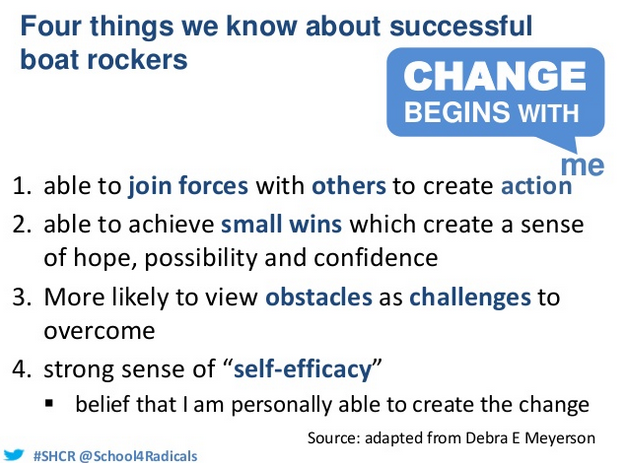
The next biggest thing I discovered is that change begins on the edges, but mobilises through networks. Not just with bigger networks of the same people, but with bridging to other networks that have the same dream. For example the project I am involved with is to provide effective interventions for young people with mental health issues who have disengaged from school. The idea is that if I try that alone I won’t get far, and if I network with other GP’s we will miss something, but by including all groups that are passionate about good outcomes for this vulnerable group, we are more likely to bring about positive and sustainable change.

The last conference you were at, did you notice that there was more expertise in the audience than on the stage? Did you know that the employees in an organisation have 10 times the social connectivity of the organisation itself, but are rarely allowed to speak the voice of the organisation? Harnessing these networks and the vast expertise brings huge momentum to change processes.

Screen Shot 2016-02-13 at 1.06.57 PM

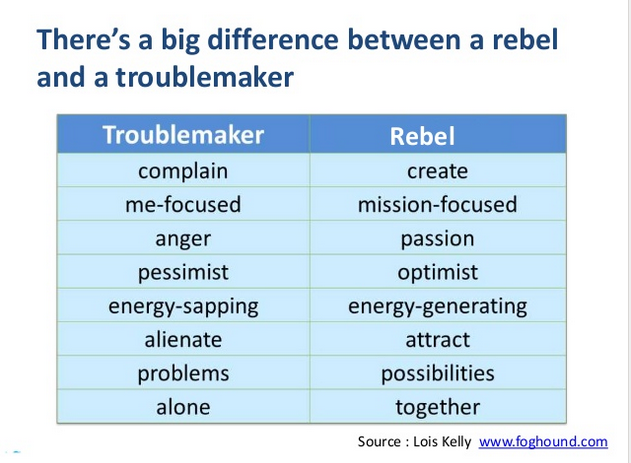
I learned that successful change embraces the trouble makers, and shifts their anger into passion. This happens by including them, and honouring their concerns, not by excluding them.

Screen Shot 2016-02-13 at 1.16.57 PM

That is my take on module one of this course. Take a look at the website or look on twitter #SHCR @School4radicals or facebook

Do you work well with troubled youth? Well perhaps you too are a mutant

Stories often emerge in our culture as metaphors for a social phenomenon, and the X-men is a great example. We have all heard of, or known families, where something emerges in adolescence that turns a previously manageable young person into a force to be reckoned with, and to mainstream education and community systems they become unmanageable. Their parents, family and teachers find the change alarming and are unable to understand how it happened or what it is. Every intervention, while well intended, seems to make things worse

In the X-men story, youths such as these that had been marginalized, bullied by peers or punished by adults without an attempt to understand them became resentful. If the adults managed to connect with them, that resentment shifted to understanding and their energy went into a useful cause. One boy, Pyro, who’s resentment was simmering over, attacked a boy who was teasing him. The head of school settled the incident but told him dismissively ” Next time you feel like showing off, don’t!” and left. The break in their relationship left the space for him to be seduced by the dark side of mutants. The mutants who’s resentment had found relief in revenge.

As Gandhi said: An eye for an eye just turns the whole world blind. Cohesive communities find a way to include marginalized minorities and help them heal the hurts that would otherwise fuel division. In patriarchal societies, breaking the rules results in blame and punishment, in a mood of negation. For an emerging x- man, digression can happen just through self expression, with gifts that are not yet understood or controlled. The punishment, then, feels unjust and fuels resentment. In matristic cultures, however, people who have digressed are included in a ritual that allows restoration of the digression, learning, and re-connection with the community, in a loving and understanding mood. The X-men knew about this.

The spectacular thing about the X-men story, is that there are adults who understand, and know what to do. In the story, these adults are called mutants by the larger community, but they wear the badge with honour. They understand the emerging abilities in the young person and view them as gifts. They do not claim a superior understanding of these abilities, because each mutants gifts are unique, but they know that the youngster can learn to explore them, learn to use them and embrace them as part of their individual uniqueness.

In the story, Charles Xavier, a talented and experienced mutant, created a school for these gifted youths, where they could learn from adults who understood them. They weren’t segregated into age groups. They learned from each other. They learned what was relevant to their unique gift. They did not learn irrelevant things.

Imagine that such a school for troubled youth was available in our community. There would be no curriculum. Learning would happen in relationship with an adult who trusted their own abilities and was not afraid of the young person’s emerging skills. Irrelevant things would no doubt be accidentally learned, (such as literacy and numeracy), but the emphasis would be on expanding the abilities of the individual youth in a way that felt relevant to them.

The importance of experiencing the world through their senses, not just their cognition, would be rightfully returned to them, as well as an understanding of why mainstream schooling did not work for them as it emphasised thinking, and not feeling, being or even doing. X-men know that over- thinking gets in the way of their powers.

Parents see their child transformed into a confident, self trusting person, experiencing success in their personal learning in areas of interest to them. They would come to understand that they needed the same length of time that kids have in mainstream schools to feel calm, happy and engaged with their peers, in order to succeed, so it would be understood that the sum of time they spent in distress before they found the school would be added to their school time. This might mean that an 18 year old with 6 troubled years might remain in the school until they were 24 before they were asked to be productive in the world (or to train as x-men).

Instead of the disconnecting experience of pathway planning that takes these young people out of their present and into some imagined future, mutant teachers understand the importance of helping these youths to stay grounded in the present, where they are connected to their senses through which they learn. As their skills grow they lay down a path into the future that is right for them. This future could not have been known in advance.

If you can imagine that, you may well be a mutant.

Lessons on anxious children from Pavlov and a labradoodle

Saffy, a 10 week old Labradoodle has joined our family and it has been an interesting reminder of how tuned in small mammals are to the emotions and moods that surround them.

Yesterday she barked at the doorbell. Our 8 year old Labradoodle doesn’t, but we can’t remember how she learned that, so back to basics, someone went to ring the doorbell a few times and my job was to make sure Saffy didn’t bark. The doorbell rang and she didn’t bark. I did nothing! She did nothing. And suddenly I realised that it wasn’t the doorbell that made her want to bark it was our response to the doorbell.

A lovely story in Brad Keeny’s “The Aesthetics of Change” tells of a researcher who took Pavlov’s experimental notes and reproduced his experiment with one omission. Pavlov rang a bell and then fed the dog. The dog, he said, became conditioned to the ring of the bell meaning food. The result was that when the bell rang the dog salivated. Konorski (1962) repeated the experiment meticulously but had a bell with no clanger. The dog still salivated. Heinz von Foerster (1976) said that the bell was a stimulus for Pavlov, not the dog!!

This interesting observation is relevant to anxiety in children. I have noticed these children are very tuned in, either to moods and emotions around them, or to other things that we may be unaware of. Culturally we have lost the distinctions to see what is actually happening for them.

If we go back in time to when these children’s abilities would have been useful to our tribe and look at how these abilities may have been recognised and mentored in children, there is not much to go on. There is quite a bit written on how Shamen and healers were able to recognise the kind of tuned in talents of children to choose who to mentor. But what about ways of tuning in to things other then healing?

What about the elders who had tuned in to where to find the buffalo. Who with years of experience couldn’t even say how they knew, but could always lead the hunters to the right place. They would recognise a fledgling talent in a child and encourage them.

What about the elder, who’s interest took them to develop sensitivities about when to plant crops, when to harvest them, about weather patterns, and who saw these fledgling sensitivities as they emerged in children.

What about elders who were tuned in to animals. Who could train the horses and dogs. Who knew when a herd animal was pregnant, or ill. Imagine the children who flourished under their guidance.

Now think of these tuned in children in our modern culture who have no mentors. Imagine they tune in… and not just to things going on in their small tribe, but with globalisation they tune in to all the pain and suffering in the world. Imagine they do school projects. Imagine they watch documentaries. Imagine they follow the news. They hear about the shrinking habitat and numbers of buffalo. They find out about global food production and world famine. Imagine they tune into global weather patterns rather than just their local environment, so instead of one bad storm in their lifetime they are aware of every natural disaster, past and present, and its impact on people. Imagine a child tuned in to animal wellbeing who might start with a family pet, but grows to watch documentaries in school on how animals are treated for food production.

If we could go back 30 years and imagine that, we might well imagine the explosion of anxiety in children.

Now, most children, when the doorbell rings, they just hear the doorbell. They are not tuned in to the response of the adults in their life. These children watch documentaries and aren’t deeply affected. These kids need mentors too but they find them easily in our modern world. When you see those kids who score well academically, who can be involved in service without suffering, who do well in sport, without feeling the negation of the competitive mood, for themselves and others, you see how well they are mentored in a way that is useful and appropriate to them. They find their natural self expression in the mainstream system of school and thrive.

But what of these other children? How can we help these kids? It would be great to identify them in infancy and know how to protect them. Turn off the TV, keep them connected in their small environment. Don’t bombard them with information. Try to work out what they are tuning into and let them explore it. These kids sometimes find mentors in a creative space. They do well at art school where being a bit weird and intuitive is valued. They can find like minded souls in an indie music scene, that values the way music evokes experience. Anywhere where experience is valued over cognition they find a place.

But what can we do for those children who have become anxious and have lost trust in themselves?

We had dinner last night with some wonderful colleagues to chew this conversation over. One of the quirkiest but most appealing ideas was to imagine a school like they had on X-men. It was called a school for the gifted, so all the parents thought that’s where their kids were going, but actually Charles Xavier was finding these kids, who had these abilities that they didn’t understand and were often scared of and he let them know there were others like them. He explained what was happening to them and let them know that he and others at the school could help them to learn about their powers so they could be useful and controllable. These kids went from fear and alienation, to finding a tribe and feeling understood and valued, and exploring their potential with a useful mentor.

Imagine that!


A blueprint for a therapeutic reframe

There have been a few things in my learning of therapy that have hit me like a ton of bricks… in a good way. A kind of student “Aha” moment. And they have mostly come from fields peripheral to therapy.

The first one was in a workshop years ago run by Melbourne psychiatrist Bill McLeod. The workshop wasn’t about therapy, it was cooked up by Rob McNeilly, hoping Bill would share some of his accumulated wisdom. He was certainly a walking encyclopedia and eloquent master of linking ideas from peripheral fields to human dilemmas.

I heard that we human beings are explaining beings. We can’t help ourselves. So when something happens we just have to come up with an explanation. This is what we do:

Something happens.

We make up a story to explain what happened.

Then, we look for evidence to support the story we made up, and we always find it. You can always find evidence for the story you made up.

Then, (and this is thee scary part) we forget we made the story up.

Then, the story LIVES US.

The trouble is, that the story, the explanation, while tranquilising, is almost always limiting.

The example I like is that we used to think the world was flat. So someone sails to sea and doesn’t come back.

Then, we make up the story that the world is flat.

Then, we look for evidence. People who sail out a long way don’t come back, people who sail out a short way do, so there must be an edge out there that the former fell off.

Then we forget that we made the story up, and people sailed to sea being lived by the limitation of their story.

We do this all the time. Depression is caused by a chemical imbalance. (Who made this story up and where did it get us?) CBT is best (Well that’s history). We do it with our children. “She is shy” “He plays up if he eats snozcumbers” The stories we make up create a future that our children live into. We do it with our clients “He is resistant.” These explanations are tranquilising, which is why we like them, but they have huge potential to limit us.

I remember hearing Julio Olalla saying that Christopher Columbus didn’t discover what he discovered because he was smarter, or had better boats, or had more money. It was because he was willing to see differently. To take a look at how he took a look.

So the blueprint for a reframe:

What story would you rather be lived by? Make that story up. Look for evidence for that story. When you find the inevitable abundance of evidence for that story, forget you made it up. Let it do what we love our explanations doing, let it become our reality.

I am cooking up a project. I am going to take some stories that seem to create suffering instead of possibility and make up a new story. My first project of this sort was about premenstrual syndrome. If your interested go to howtotrainyourhormones.com

My next project tackles the growing phenomenon of anxious children. Stay tuned for a made up story that brings possibility instead of suffering.

If you have an area of interest in your work, and the prevailing story is one of suffering, but your story is one of possibility, don’t wait for science to catch up. Make some noise. Start by leaving a comment here. If you want some support to grow your idea, I recommend Bill O’Hanlon’s book writing course. I found it a wonderfully supportive way to get some clarity to write something useful.


The Therapeutic Relationship

We know from outcome research that the therapeutic relationship is an important factor. Bruce Wampold says the actions that characterize effective therapists are “warmth and acceptance, empathy, and focus on other.” But it is the colaborative nature of the work of psychotherapy that builds the relationship. Early gains create a better alliance and a better outcome.

I had a maths teacher in high school. He was old, bald and large. Kind of your stereotypical 1970’s maths teacher. He was not warm. I wouldn’t have called him empathic. If anything he was aloof and a little intimidating, but boy could he teach maths. I liked him for many reasons, particularly for the way he handled a friend of mine. This boy was smart and outspoken, and mucked up in every class. Teachers got exasperated with him and ended up losing their dignity and our respect. This guy was different. He was straight, firm and fair, no matter how provoked. He had a way of diverting the muck up and getting back on task. He was doggedly attached to teaching us maths, and I would say he was doggedly attached to us learning, my friend included. I think we all felt the investment he had in us, not for him, but for us. There was no criticism, and no praise, there was just learning maths. I liked maths. Early on my father spent time with me, I see now, in deliberate practice. Doing homework and then whipping up my enthusiasm for extra practice. Those early gains meant I was good at maths by the time I hit this man’s class.

One of my indelible memories was of learning logarithms, which we did the old way with logarithm books. I thought it was stupid and irrelevant at first. I think he must have known, because I was normally such a girly swot, and this was different. I remember talking to my mum about this and she suggested I think about it as mental gymnastics. Do it for fun, learning a skill with no relevance, just to see if you can. So I did. When he was walking around the room handing our tests back he got to mine. The look on his face scared me, and there was a slight raise of his eyebrow as he made eye contact with me. I looked at my mark of 100% and looked back up, but he was gone. It felt very good. I went on to get the prize for advanced maths at the end of high school. A good outcome.

The teacher student relationship I had with him was pivitol, but to call it warm and empathic would not only be wrong, but it would miss the best bit, which I think was the power of his belief.

One of my favourite stories that Erickson told about his work is written up in The Letters of Milton H Erickson (Zeig & Geary p 122 – 127) In 1936 he worked with a 24 year old Italian flutist who came to him demanding hypnosis for a swollen, chapped lower lip which he’d had for 6 years despite all attempts to treat it. The session reads like 2 Napoleans going head to head with binds and therapeutic double binds flying around the room. There was nothing warm or empathic about the relationship but Erickson was intensely invested in this fellows therapy, and doggedly attached to the outcome. Like my maths teacher he didn’t get triggered by the client’s bad behaviour, he didn’t get exasperated, there was total acceptance of the client and his problem dance, and total belief that the therapy would work. The man’s long history of resignation about a possible cure stood no chance in the face of Erickson’s dogged determination. It was clear though that Erickson felt light and playful, I could almost hear him chuckle as I read his words. The lip healed and the man got a job as first flutist in the W.P.A orchestra. A good outcome.

Erickson said that the client didn’t need to like him, they just needed to know that he could do therapy. He also said “Just do good work.”

I wonder if the emphasis on the warm fuzziness of the therapeutic relationship may have clouded our looking at what it really is that we do, when we do good work.

What do you think?