Mental health, toasters and social transition.

Like many Australians, I have been very stirred up by the events of the week. A man asks a question on Q and A that thousands if not millions of Australians have asked themselves. Then a well intended fellow does what many of us thought was a nice thing, without questioning his right to put this man at centre stage. The paternalism and missionary zeal at rescuing the poor savage is so transparently present in our present from our ancestors DNA that many good people forget to question such a pull to action. Indeed they felt it themselves and then found relief in giving to this cause that spoke to them.

I had a moment where I thought we might actually get some real debate, from real Australians not filtered through media self interests. And then the tribalism began. “The he said, she said” The trial by fire. The guilty until proven innocent. Another primal aspect of our humanity fanned into flame. Fanned into flame, in this case by the media self interests. And the tall poppy falls.

All human endeavors through history that fight for human rights have not been without casualties. The suffragettes were blamed and demonized and many saw that only violence was a language that could be understood. The oppressed, violently pushed down, often violently retaliated. And some didn’t. Gandhi grew the power of non-violent non cooperation, but even he couldn’t stop the Civil war that slaughtered innocents even when their victory was at hand.

In Australia, women have had the vote since 1908, though not yet equal pay. Indigenous people did not get the same voting rights as other Australians until 1965, but still have inequality in all Western standards of health and wellbeing. Nelson Mandella got the right to vote for the first time in 1994 in the election that made him president. Imagine that! Yet still, if an indigenous man had asked this same question in Q&A would anyone have wanted to buy him a toaster? What if a woman had asked?

Under all of this lies the last frontier. The child who lives in poverty. Third or fourth generation of poverty and concomitant mental ill health. We all see them. We watch them grow their own mental ill health. From beautiful baby to harried toddler. It’s such a complex story that it’s hard to know how to speak it. For me, as a young GP, more than 2 decades ago, I saw these babies and their young parents as the great Aussie battlers. Against all odds. Blamed more than they were helped. I have worked in General Practices that would refuse to see, even mothers and toddlers because they had missed appointments, with no understanding  that they were punishing them for a symptom of the problem for which they so needed help. After  attending a talk by our human rights commissioner I now have the tools to advocate for such a person, but to have to advocate to doctors for basic human rights is not something I ever envisaged. So often when seeing such patients I found myself thinking that if I had had to endure what they had had to endure I would not have been doing so well.

25 years on and nothing has changed for this minority, and again we see a lonely voice shredded. And where are the Gandhi’s, Mandellas, Martin Luther King Jr’s, who know how to make visible the inconvenient and generate a mood of public debate that grows solutions and change?

“History will have to record that the greatest tragedy of this period of social transition was not the strident clamor of the bad people, but the appalling silence of the good people.” Martin Luther King, Jr.

If you feel moved to speak, please leave a comment.
Rethinking childhood trauma on Anzac Day

I have been attending some monthly meetings held by the Commissioner for Children, and this month Narelle Whatley A PhD Candidate At the School of Social Science UTAS, presented some of her thesis on “Young people’s experience of family violence” The thing I have been left with the most is that  most people who suffered childhood abuse or trauma, didn’t seek counselling, even as adults. I’m sure I’d heard this before, but somehow it hit me differently.

I had been immersed in reading and listening to world experts on trauma treatments over the last while and suddenly I was hit by the image of these experts with all their knowledge, worlds apart from the child who pretty soon works out no one can help so keeps quiet. I got a sense of their world through the voices presented. I hadn’t noticed that part of the reason they don’t find a trusted adult early on is that they moved houses and schools so often. I revisited my own emotional experience of early school life and imagined adding a new house, school, teacher, peers… well no wonder.

Then I thought about the children I am seeing and have seen who’s early life was tumultuous and terrifying, and they have all been brought along by someone else, usually an adult who has some working responsibility for them and needs help. I have routinely asked all these children what had made a difference to them, dealing with all they were dealing with, and the thing that stands out is the rare, infrequent, connection with someone who cared about them and believed in them. It may have been a grandparent or other relative but was commonly a trusted teacher. The thing that helped was not that they intervened in the violence and tried to fix it, but that they somehow allowed the child to believe in themselves.

Neuroscience has given us an amazing understanding of the traumatized brain and the trauma response but has made no difference to the effectiveness of treatment. As Cloe Madanes famously said “Satisfying human relationships can be the most healing “medications” of all. No amount of exercise, meditation, massage, stress reduction or broccoli is an adequate substitute for love and affection for promoting health.

It then occurred to me that if we really want to make a difference to children it might be good to look at things from their perspective. What would be helpful for a child who is suffering, but is protective of their parents and doesn’t want them to get into trouble? What would help the child who stays silent because they perceive that the social interventions in place to help would actually make things worse for them? How do we ask the questions that might actually make life better for such a child and their family?

I think it will take a cultural change. Humberto Maturana, Chilean biologist, gives the best description of how cultural change happens in his talk/writings about the origins of patriarchy. It starts with a change in emotion, which is taken on for some reason or other, not as a manner of living for the adults, but for some greater good. But, when children are born into this new way, they take it on as a manner of living, and it becomes transparent.

What if doctors, nurses, antenatal nurses, obstetricians, child health nurses, pediatricians, social workers, early childhood intervention and family workers, child care workers, Centrelink officers, drug and alcohol workers, psychiatrists, psychiatric nurses, police, ambulance officers, the justice system, family law courts, teachers, teachers aids, sports coaches, gym coaches, bank tellers, shop assistants and tv celebrities, started with love, affection and broccoli anytime they were confronted with a child or family exhibiting what trauma experts would know as the hyper-arousal of trauma symptoms, hitherto thought to be bad behaviours by all of the above.

“Satisfying human relationships can be the most healing “medications” of all. No amount of exercise, meditation, massage, stress reduction or broccoli is an adequate substitute for love and affection for promoting health.” Cloe Madanes

WORKING WITH DISSOCIATION: When reconnecting is not enough

As a medical undergraduate, I found Psychiatry to be such a strange abstraction, that seemed to be about types of people that I’d never met. I was taught that neurosis was something that was within normal human experience, but that psychosis was not. It just didn’t prepare me to deal with patients in General Practice who suffered from extreme forms of dissociation, and I felt ill equipped to help. Somewhere in the next 10 years I discovered how to see the person, not the DSM category, and got to know many interesting individuals, who reminded me of a lot of people I had met in my life. I could see that my part in actively building our relationship helped them. When I then began to learn about Solution Oriented Therapy and then the work of Milton Erickson, I finally discovered that there were ways that I could be more useful.

Now, another 16 years on, I would have some things to say to my younger self. I would tell her that dissociation is in fact a normal human experience. I would remind her of the imaginary games she played as a kid where textured stories unfolded and it was as if these things were really happening.  I would remind her of her daydreams, where quite bizarre realities could feel very real. I would remind her of the time she had a fever and floated around the ceiling looking down on herself, managing not to be afraid because of the soothing voice of her mother. I would remind her of the time when she was sitting in the sun in the family room and saw her old grey tabby cat out of the corner of her eye, and then, when she turned to talk to him, it was just a bundled up jumper, not even the right colour really, and she was so surprised at how real he had seemed that she tried to get that vision again out of the corner of her eye… but couldn’t. I would remind her of the creative spaces she would get into, drawing, building, creating, with ideas that defied logic, as the “real world” disappeared and time sped up, or slowed down. Then there were those optical illusions, and magic eye images. If she could be so easily tricked, couldn’t anyone?

She knew then, that in the moment of perceiving, there was no way of knowing the difference between an illusion and reality, so what was so hard to understand about someone hallucinating, or getting stuck in an unhelpful delusion. By seeing dissociation on a spectrum of normal everyday experiences it is easier to understand, and therefore easier to connect with clients who experience it.

Dissociative skills are helpful when fear and trauma drive someone to want to get out of their own experience. Dissociation becomes a haven, an escape from an unwanted bodily experience, but the mood of this dissociating is sometimes very different to a playful daydream. It is a very useful skill while the danger and damage is still happening, but can be problematic if it is hanging around when the danger has passed. The most remarkable description of the protective nature of dissociation I have heard was from a man who’s childhood was a constant barrage of verbal, emotional, physical and sexual abuse, and yet somehow he managed to really believe that he was lovable. He let himself experience love, sometimes in magical ways. In primary school he pretended that his loving teacher was actually his father, and every morning his teacher greeted him he felt it as a ‘good morning’ from a loving father. He went on to have a successful life, married and had children, and had fulfilling relationships with all of them. He developed enough control of his dissociation that it became psychologically protective in any dangerous situation, and shielded him from pain. If that was possible for him, just imagine what we are able to co-create in a therapeutic relationship.

Most people have daydreamed in class but remain aware enough of “reality” that they hear their name if asked a question, even if they weren’t present for what was said. People rarely wet themselves because they were so absorbed in a daydream that they didn’t attend to a full bladder. You can be absorbed in a book, but still answer the phone when it rings, adjusting quickly to the new reality.

Neuroscience informs us that what the brain practices it gets good at, and people with extreme dissociation have certainly practiced. If there were a competition for dissociative skills, these people would be the Olympic team. Olympians, however, leave their skills on the field. They don’t tend to hurl javelins at the dinner table, and so don’t appear strange to us.

My take on dissociation, when it is a problem, is just that control has been lost. Fear gets in the way of learning, so the more ordinary we can make these experiences, the more connections to everyday examples we make, the easier it is to learn, and to reclaim control.

I have noticed that people who dissociate in a problematic way, very often have learned a few tricks to stay in the room. I had a client who would scratch his palm with the fingernails of the same hand, another who placed a hand on her shoulder under her shirt and kept the awareness of the touch. Others who pick at clothing. I have noticed that complimenting them on finding a way to stay in the room often surprises them as they don’t know they are doing it, but as soon as they realise they are more in control. I then wonder with them what other things they do that they don’t even know they are doing, and often surprising rememberings appear.

The phenomenon of dissociation can be seen in all problems that clients present with, from learning difficulties in school children, through fears and phobias, trauma responses, to the more extreme end of the spectrum of dissociative disorders, and schizophrenia. Most therapy models generate an experience of reconnection, so that a client goes from a disconnected (all over the place like a mad woman’s knitting) experience, to a connected (cooking with gas) experience, where client resources become available again, and learning can happen. However, when the client does not have control of their own dissociative experience, simply generating reconnection will not be enough.

Dissociation is a powerful skill, that can veer out of control when no-one is in the drivers seat. By understanding and utilising this ability, a therapist can work with a client to enable them to grasp the wheel of their own experience. When helping a client to explore the phenomenon of their own dissociation, we can be a useful mentor in the passenger seat of the client’s experience as they discover that they can drive.


Tests test the test, not the tested

If all the people in the world lay on the ground, head to foot around the world, two thirds would drown.

I was a medical student when I heard this absurd statement. Perhaps I was not quite ready to see the relevance to statistical proclamations about humans, but something about it has always tickled me. Human beings are just not standard enough for statistical statements about them to remain static decade after decade. People are getting taller, larger, living longer, surviving childbirth more often, and all the while the planet remains two thirds covered by water. So what does a statistic that stays the same mean?

A good example is Herbert Spiegel’s hypnotisability scale. I never much liked the notion, but if you do it, you find 25% of the population are not hypnotisable. Stories of Erickson’s students turning up at these demonstrations and helping these non hypnotisable people experience trance in their own way, of course appeal to my mischievous side. The finding is a result of the construct of the test itself.

So what of the effectiveness of psychotherapy that has remained the same for the more than 50 years that we have been measuring it? What if it doesn’t actually say anything about people, it just measures the construct of psychotherapy and the goals therein?

Heinz Von Foerser, one of my heroes seemed to understand this kind of thing. He said that tests test the test, not the person being tested.


Reflections from the School of Health and Care Radicals

I was sent a link to The School For Health and Care Radicals ( #SHCR ) a couple of weeks ago. Cool title I thought, so I took the typical 7 and a half seconds to look. It is a free online training initiative from somewhere in the NHS in the UK.

Then I saw it…. “How to rock the boat, without falling out”.  It spoke to all my past frustrations where good ideas that I was initially fired up about, and keen to contribute to,  came up against the inertia of the system, and inevitably after a variably long and exhausting process, fizzled, and I took my bat and ball and left.

This school though, offers new hope and new ideas, with a distillation of what works. A novel idea, I know, to look at how great ideas actually became great actions, and see if, by replicating the “how”, we could be more successful in bringing innovative endeavours to life.

So Here’s what Ive learned so far:

The old pilot project is on the way out. They take too long and cost too much. Waiting 18months to find out your idea didn’t work wastes time, resources and energy. Change projects are now brief experiments. They are 30, 60 or 90 day projects or prototypes and require minimal infrastructure yet deliver useful information. Quite like the wave of pop-up restaurants, shops etc. they provide a similar efficient use of resources and you get immediate feedback.

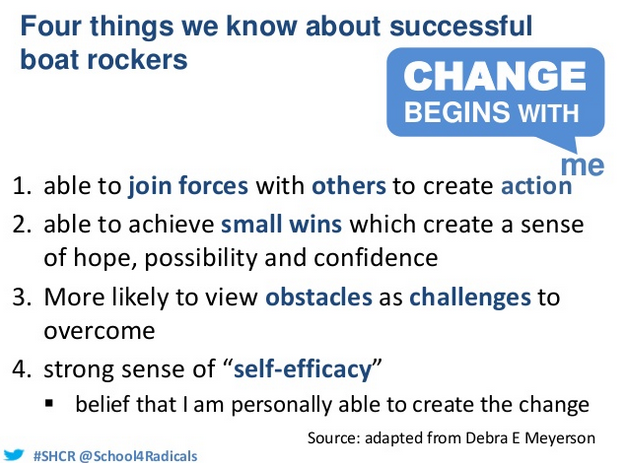
The next biggest thing I discovered is that change begins on the edges, but mobilises through networks. Not just with bigger networks of the same people, but with bridging to other networks that have the same dream. For example the project I am involved with is to provide effective interventions for young people with mental health issues who have disengaged from school. The idea is that if I try that alone I won’t get far, and if I network with other GP’s we will miss something, but by including all groups that are passionate about good outcomes for this vulnerable group, we are more likely to bring about positive and sustainable change.

The last conference you were at, did you notice that there was more expertise in the audience than on the stage? Did you know that the employees in an organisation have 10 times the social connectivity of the organisation itself, but are rarely allowed to speak the voice of the organisation? Harnessing these networks and the vast expertise brings huge momentum to change processes.

Screen Shot 2016-02-13 at 1.06.57 PM

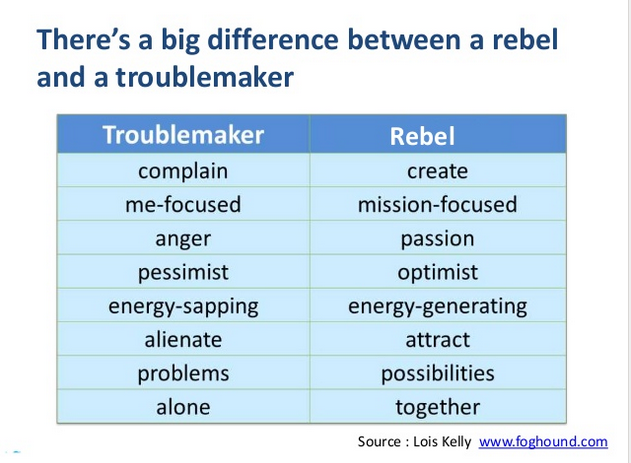
I learned that successful change embraces the trouble makers, and shifts their anger into passion. This happens by including them, and honouring their concerns, not by excluding them.

Screen Shot 2016-02-13 at 1.16.57 PM

That is my take on module one of this course. Take a look at the website or look on twitter #SHCR @School4radicals or facebook

Lessons on anxious children from Pavlov and a labradoodle

Saffy, a 10 week old Labradoodle has joined our family and it has been an interesting reminder of how tuned in small mammals are to the emotions and moods that surround them.

Yesterday she barked at the doorbell. Our 8 year old Labradoodle doesn’t, but we can’t remember how she learned that, so back to basics, someone went to ring the doorbell a few times and my job was to make sure Saffy didn’t bark. The doorbell rang and she didn’t bark. I did nothing! She did nothing. And suddenly I realised that it wasn’t the doorbell that made her want to bark it was our response to the doorbell.

A lovely story in Brad Keeny’s “The Aesthetics of Change” tells of a researcher who took Pavlov’s experimental notes and reproduced his experiment with one omission. Pavlov rang a bell and then fed the dog. The dog, he said, became conditioned to the ring of the bell meaning food. The result was that when the bell rang the dog salivated. Konorski (1962) repeated the experiment meticulously but had a bell with no clanger. The dog still salivated. Heinz von Foerster (1976) said that the bell was a stimulus for Pavlov, not the dog!!

This interesting observation is relevant to anxiety in children. I have noticed these children are very tuned in, either to moods and emotions around them, or to other things that we may be unaware of. Culturally we have lost the distinctions to see what is actually happening for them.

If we go back in time to when these children’s abilities would have been useful to our tribe and look at how these abilities may have been recognised and mentored in children, there is not much to go on. There is quite a bit written on how Shamen and healers were able to recognise the kind of tuned in talents of children to choose who to mentor. But what about ways of tuning in to things other then healing?

What about the elders who had tuned in to where to find the buffalo. Who with years of experience couldn’t even say how they knew, but could always lead the hunters to the right place. They would recognise a fledgling talent in a child and encourage them.

What about the elder, who’s interest took them to develop sensitivities about when to plant crops, when to harvest them, about weather patterns, and who saw these fledgling sensitivities as they emerged in children.

What about elders who were tuned in to animals. Who could train the horses and dogs. Who knew when a herd animal was pregnant, or ill. Imagine the children who flourished under their guidance.

Now think of these tuned in children in our modern culture who have no mentors. Imagine they tune in… and not just to things going on in their small tribe, but with globalisation they tune in to all the pain and suffering in the world. Imagine they do school projects. Imagine they watch documentaries. Imagine they follow the news. They hear about the shrinking habitat and numbers of buffalo. They find out about global food production and world famine. Imagine they tune into global weather patterns rather than just their local environment, so instead of one bad storm in their lifetime they are aware of every natural disaster, past and present, and its impact on people. Imagine a child tuned in to animal wellbeing who might start with a family pet, but grows to watch documentaries in school on how animals are treated for food production.

If we could go back 30 years and imagine that, we might well imagine the explosion of anxiety in children.

Now, most children, when the doorbell rings, they just hear the doorbell. They are not tuned in to the response of the adults in their life. These children watch documentaries and aren’t deeply affected. These kids need mentors too but they find them easily in our modern world. When you see those kids who score well academically, who can be involved in service without suffering, who do well in sport, without feeling the negation of the competitive mood, for themselves and others, you see how well they are mentored in a way that is useful and appropriate to them. They find their natural self expression in the mainstream system of school and thrive.

But what of these other children? How can we help these kids? It would be great to identify them in infancy and know how to protect them. Turn off the TV, keep them connected in their small environment. Don’t bombard them with information. Try to work out what they are tuning into and let them explore it. These kids sometimes find mentors in a creative space. They do well at art school where being a bit weird and intuitive is valued. They can find like minded souls in an indie music scene, that values the way music evokes experience. Anywhere where experience is valued over cognition they find a place.

But what can we do for those children who have become anxious and have lost trust in themselves?

We had dinner last night with some wonderful colleagues to chew this conversation over. One of the quirkiest but most appealing ideas was to imagine a school like they had on X-men. It was called a school for the gifted, so all the parents thought that’s where their kids were going, but actually Charles Xavier was finding these kids, who had these abilities that they didn’t understand and were often scared of and he let them know there were others like them. He explained what was happening to them and let them know that he and others at the school could help them to learn about their powers so they could be useful and controllable. These kids went from fear and alienation, to finding a tribe and feeling understood and valued, and exploring their potential with a useful mentor.

Imagine that!


A blueprint for a therapeutic reframe

There have been a few things in my learning of therapy that have hit me like a ton of bricks… in a good way. A kind of student “Aha” moment. And they have mostly come from fields peripheral to therapy.

The first one was in a workshop years ago run by Melbourne psychiatrist Bill McLeod. The workshop wasn’t about therapy, it was cooked up by Rob McNeilly, hoping Bill would share some of his accumulated wisdom. He was certainly a walking encyclopedia and eloquent master of linking ideas from peripheral fields to human dilemmas.

I heard that we human beings are explaining beings. We can’t help ourselves. So when something happens we just have to come up with an explanation. This is what we do:

Something happens.

We make up a story to explain what happened.

Then, we look for evidence to support the story we made up, and we always find it. You can always find evidence for the story you made up.

Then, (and this is thee scary part) we forget we made the story up.

Then, the story LIVES US.

The trouble is, that the story, the explanation, while tranquilising, is almost always limiting.

The example I like is that we used to think the world was flat. So someone sails to sea and doesn’t come back.

Then, we make up the story that the world is flat.

Then, we look for evidence. People who sail out a long way don’t come back, people who sail out a short way do, so there must be an edge out there that the former fell off.

Then we forget that we made the story up, and people sailed to sea being lived by the limitation of their story.

We do this all the time. Depression is caused by a chemical imbalance. (Who made this story up and where did it get us?) CBT is best (Well that’s history). We do it with our children. “She is shy” “He plays up if he eats snozcumbers” The stories we make up create a future that our children live into. We do it with our clients “He is resistant.” These explanations are tranquilising, which is why we like them, but they have huge potential to limit us.

I remember hearing Julio Olalla saying that Christopher Columbus didn’t discover what he discovered because he was smarter, or had better boats, or had more money. It was because he was willing to see differently. To take a look at how he took a look.

So the blueprint for a reframe:

What story would you rather be lived by? Make that story up. Look for evidence for that story. When you find the inevitable abundance of evidence for that story, forget you made it up. Let it do what we love our explanations doing, let it become our reality.

I am cooking up a project. I am going to take some stories that seem to create suffering instead of possibility and make up a new story. My first project of this sort was about premenstrual syndrome. If your interested go to howtotrainyourhormones.com

My next project tackles the growing phenomenon of anxious children. Stay tuned for a made up story that brings possibility instead of suffering.

If you have an area of interest in your work, and the prevailing story is one of suffering, but your story is one of possibility, don’t wait for science to catch up. Make some noise. Start by leaving a comment here. If you want some support to grow your idea, I recommend Bill O’Hanlon’s book writing course. I found it a wonderfully supportive way to get some clarity to write something useful.


The Therapeutic Relationship

We know from outcome research that the therapeutic relationship is an important factor. Bruce Wampold says the actions that characterize effective therapists are “warmth and acceptance, empathy, and focus on other.” But it is the colaborative nature of the work of psychotherapy that builds the relationship. Early gains create a better alliance and a better outcome.

I had a maths teacher in high school. He was old, bald and large. Kind of your stereotypical 1970’s maths teacher. He was not warm. I wouldn’t have called him empathic. If anything he was aloof and a little intimidating, but boy could he teach maths. I liked him for many reasons, particularly for the way he handled a friend of mine. This boy was smart and outspoken, and mucked up in every class. Teachers got exasperated with him and ended up losing their dignity and our respect. This guy was different. He was straight, firm and fair, no matter how provoked. He had a way of diverting the muck up and getting back on task. He was doggedly attached to teaching us maths, and I would say he was doggedly attached to us learning, my friend included. I think we all felt the investment he had in us, not for him, but for us. There was no criticism, and no praise, there was just learning maths. I liked maths. Early on my father spent time with me, I see now, in deliberate practice. Doing homework and then whipping up my enthusiasm for extra practice. Those early gains meant I was good at maths by the time I hit this man’s class.

One of my indelible memories was of learning logarithms, which we did the old way with logarithm books. I thought it was stupid and irrelevant at first. I think he must have known, because I was normally such a girly swot, and this was different. I remember talking to my mum about this and she suggested I think about it as mental gymnastics. Do it for fun, learning a skill with no relevance, just to see if you can. So I did. When he was walking around the room handing our tests back he got to mine. The look on his face scared me, and there was a slight raise of his eyebrow as he made eye contact with me. I looked at my mark of 100% and looked back up, but he was gone. It felt very good. I went on to get the prize for advanced maths at the end of high school. A good outcome.

The teacher student relationship I had with him was pivitol, but to call it warm and empathic would not only be wrong, but it would miss the best bit, which I think was the power of his belief.

One of my favourite stories that Erickson told about his work is written up in The Letters of Milton H Erickson (Zeig & Geary p 122 – 127) In 1936 he worked with a 24 year old Italian flutist who came to him demanding hypnosis for a swollen, chapped lower lip which he’d had for 6 years despite all attempts to treat it. The session reads like 2 Napoleans going head to head with binds and therapeutic double binds flying around the room. There was nothing warm or empathic about the relationship but Erickson was intensely invested in this fellows therapy, and doggedly attached to the outcome. Like my maths teacher he didn’t get triggered by the client’s bad behaviour, he didn’t get exasperated, there was total acceptance of the client and his problem dance, and total belief that the therapy would work. The man’s long history of resignation about a possible cure stood no chance in the face of Erickson’s dogged determination. It was clear though that Erickson felt light and playful, I could almost hear him chuckle as I read his words. The lip healed and the man got a job as first flutist in the W.P.A orchestra. A good outcome.

Erickson said that the client didn’t need to like him, they just needed to know that he could do therapy. He also said “Just do good work.”

I wonder if the emphasis on the warm fuzziness of the therapeutic relationship may have clouded our looking at what it really is that we do, when we do good work.

What do you think?


Professional jet lag at the Ericksonian Congress

I had such a big reaction to reading my own blog this morning! It was a blog I wrote and scheduled to publish a week ago in Hobart Australia and the blog I read this morning in Phoenix Arizona, after being immersed in the soup of the Erickson Congress for the last 3 days.

When I was a medical student, some research came out of our own University saying that digoxin didn’t work for heart failure, unless the patient had atrial fibrillation. That its action was not in fact on the hearts strength but in effecting the rate of fibrillation thereby making the heart more efficient. I remember thinking, that’s a little strange. Digoxin comes from the fox glove plant and human beings have been using it long before modern medicine, but Ok I trust you, I’m new at this and you know more. 5 years later they said, well actually it does work to strengthen the heart. There have been lots of things like that in medicine but I have never been made to feel wrong, or stupid for doing what research informed me was the right thing to do.

I have been hanging out with therapists in Phoenix. Big hearted, loving, compassionate people, committed to their work and professional development. These therapists do good work. They want to be effective in their work. The field has been patiently waiting for science to give some useful direction, and in it’s absence, they just get on and do good work, developing sensitivities that help them to genuinely assist more people in more ways.

As Erickson said: Just do good work!

Humbling and refreshing at the same time.

What causes mental illness and why did the chicken cross the road?

According to Humberto Maturana:

An every day explanation is always an answer to the question about the origin of the phenomenon to be explained, and is accepted or rejected by the listener depending on whether or not it satisfies certain criteria of acceptability that the listener specifies.

For example: Q: “Where do babies come from?” A: “The stork brings them”

Cool!

A scientific explanation, however, is the criterion of validation of a scientific statement. It specifies the phenomenon to be explained. It provides a generative mechanism (the hypothesis), that if it is allowed to operate, gives rise to the phenomenon to be explained, and tells you what to do so that if you do it you will be able to observe the phenomenon that it was explaining in the first place.

For example: Storks are tuned in to the electromagnetic field that is produced when 2 human beings are having sex. The stork appears 9 months later creating a blip in the time space continuum …. ahhh maybe not.

Lets walk down memory lane past a few signposts of everyday explanations:

Depression is caused by a chemical imbalance in the brain! Well, not so much, but drug companies made a lot of money while we thought so.

Severe mental ill health is biological and only responds to medication! Hmmmm, it turns out not to be that simple, and again, drug companies are doing better than patients.

Mental illness has a genetic cause. Well, there might be a small part to play, but its hard to distinguish from the environmental influence of being raised by a mentally ill parent.

CBT is best practice for treating mental illness. Not so. Just ask the Swedes.

Mental illness is created by storks!

What is more interesting to me is not what caused it, but how can we get better at assisting recovery. I am still shaking my head after reading that the NIMH spent 11 million US dollars on 8 studies between 1992 and 2009 that pitted one therapy model against another and found again what we have known since Rosenzweig in 1936 described the dodo bird effect. We need to start asking different questions so that money for research can be used more wisely.

Consider the question: “Why did the chicken cross the road?”

A scientist would provide a generative mechanism, that if it were allowed to operate would result in the chicken crossing the road, and would be reproducible. Anything else is just philosophical speculation. A more interesting question, however, might be “was the chicken’s wellbeing improved by crossing the road?” and if so, how can we assist more chickens to cross more roads?

I dream of a day where a chicken can cross the road without having it’s motives questioned, and where the next $11 million the NIMH spends is to discover something useful that we don’t know, that improves outcomes for people with mental illness.

Share this post if you agree.